VINfakta - Helge Skansen |
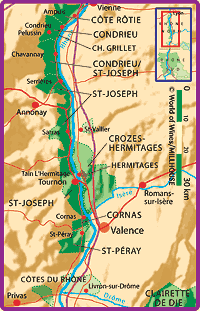
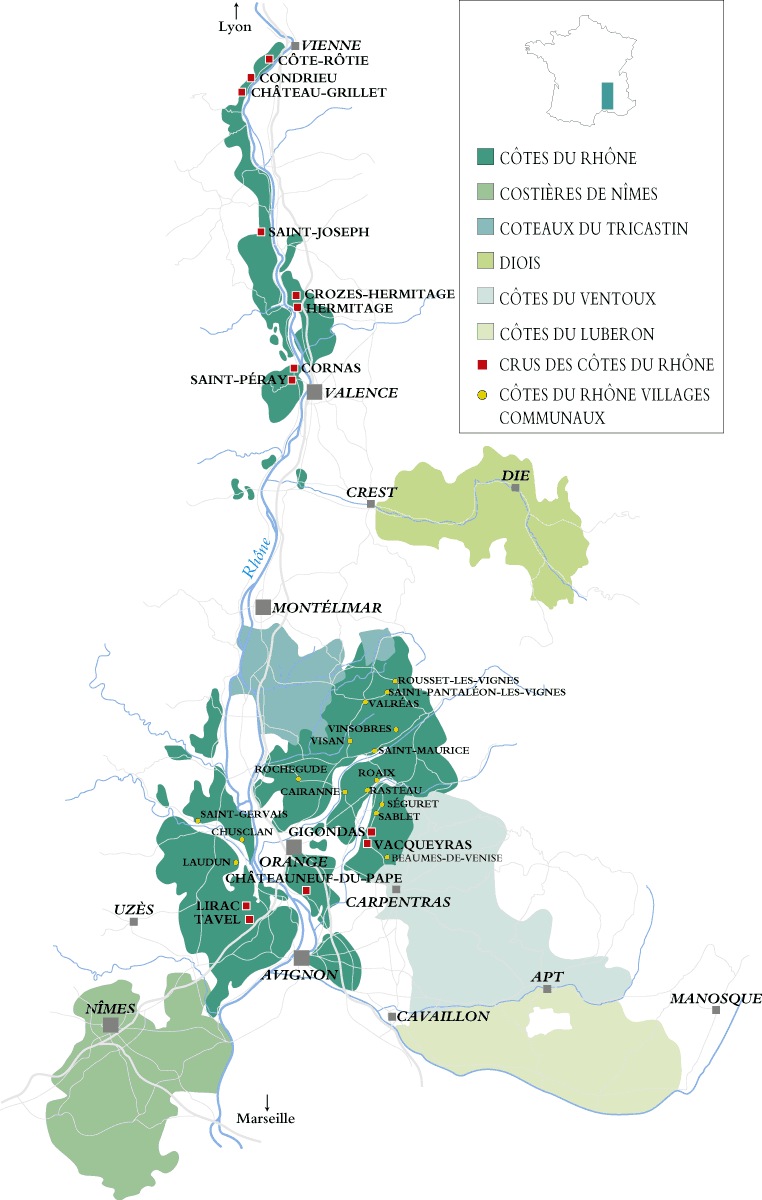
På sin ferd fra isbreene i de sveitsiske alper til Middelhavet utenfor Provence, passerer elven Rhône mange spennende vindistrikter, og tar også på veien opp i seg elven Saône som renner gjennom Burgund. Vinappelasjonene som omkranser de 20 milene mellom Vienne og Avignon har fått en fellesbetegnelse etter elvens navn - Côtes du Rhône. Det hele starter øverst i Rhônedalen mellom Massif central og Préalpes der vinterrassene i granittåsene overfor Vienne gir liv til de kanskje flotteste rødvinene i distriktet; Côte Rôtie ("brent åsside"). Ferden fortsetter gjennom Condrieu og Château-Grillet, flotte endruehvitviner laget på voignier, videre til Saint-Joseph, Cornas og Saint-Péray, og på den andre siden av elven Hermitage og Crozes-Hermitage. Til sammen danner disse distriktene i Nord-Rõhne med temperert klima, bratte terrasserte vinmarker og granitt- og skiferjord en egen sone med fokus på høy kvalitet og primært endrueviner - syrah til røde (røyk- og bjørnebæraromaer) og marsanne og rousanne til hvite. Druedyrking i dette området er hardt manuelt arbeid uten maskinhjelp, noe som avspeiles i prisene. Etter byen Montélimar flater terrenget ut og vi kommer inn i det sørlige Rhône.
Jeg har prioritert å ta med alle AOC-distriktene i nord med unntak av Saint-Péray. Her lages fin musserende vin av druene rousanne og marsanne - bløtere og fruktigere enn champagne. Fra syd har jeg fokusert på Châteauneuf-du-Pape, som er det ubestridte kvalitetsområdet der.
En fin introduksjon til Nord-Rhône er Per Mælengs artikkel Syrahs paradis på Aperitif.
Skal du virkelig fordype deg, anbefales boken The Wines of the Northern Rhône av John Livingstone-Learmonth. På hans websider finner du masse vurderinger av enkeltprodusenters viner/årganger.
En nyttig webside for planlegging av en vintur i Rhône er The wines of Côtes du Rhône som bl.a. redegjør for forskjellige rutealternativer.
En vintur til Rhône kan absolutt anbefales. Det må sies at området er mer lukket med tanke på gårdsbesøk og utsalg enn mange andre vinområder. Produsentene har vel nok med å stelle sine steile vinmarker. Er dere en gruppe, kan derimot besøk lett avtales også hos de beste produsentene. Som en liten starthjelp, foreslår jeg en minimumsrute, så er det bare å planlegge videre selv. (Avstem avreisedag etter restaurantenes fridager.) Se under det enkelte AOC for tips om hotell, restaurant, vinutsalg etc. Hva gjelder priser, må du forberede deg på at kvalitetsvin fra de beste produsentene koster mye også lokalt. I utsalgene bør du kunne spare 20-30% i forhold til Vinmonopolet. På restauranter blir det fort et påslag på 20-100% på butikkprisene.
Er du musikkinteressert, så har Vienne en flott internasjonal jazzfestival - Jazz à Vienne - de to første ukene i juli.
Dag 1:
Morgenfly til Montpelliere (billig direktefly fra Norge, alternativt kan du fly SAS til Lyon). Lei bil og ta motorveien til Vienne. Trivelig by med mange historiske etterlevninger.
Dag 2:
Utforsk Ampuis (Côte Rôtie) og Condrieu. De to beste og billigste vinutsalgene jeg har kommet over i dalen ligger i disse to landsbyene. Svært mange av €-prisene som du finner under produsentomtalene er fra disse to utsalgene (i 2006). Dersom du har råd, så avslutt med middag på 2-stjernes La Pyramide i Vienne (bestill bord!). Dersom du ikke tar helt av på vinmenyen, kommer du langt med kr. 2000 pr. hode. Det er verdt hver krone.
Dag 3:
Neste etappe beveger seg gjennom Saint-Josep og ned til Hermitage. Aktuelle stoppesteder er Chavanay, Malleval, og Serrièrer, der en lunsj på restaurant Schaeffer er vel anvendte penger.
Du kan overnatte i Tain l'Hermitage, eller som jeg foretrekker, over elven i Tournon sur Rhône. Her finner du også et av de beste vinkartene i området på restauranten Le Chaudron.
Dag 4:
En tur opp til Hermitageberget anbefales sterkt - enten til fots eller opp fra baksiden med bil . En sveip innom Crozes-Hermitage kan kobles med det siste. Det finnes et par vinutsalg i Tain, samt Chapoutiers utsalg av egne produkter. Et besøk på sjokoladefabrikken Valhronas utsalg bør du også få med deg. Turen går så videre sydover gjennom Cornas og Saint-Péray i retning Châteauneuf-du-Pape, der du kan overnatte. Et lunsjstopp hos Michel Chabran i Pont-de-l'Isère er også å anbefale for de som vil få med seg flest mulig kulinariske høydepunkter. Et alternativ til overnatting i Châteauneuf-du-Pape er Restaurant La Beaugraviére som har 3 rom (Route nationale 7, Mondragon, +33 (0)4 90408254, fax +33 (0)4 90409101). Et himmelrike for de som vil begi seg ut på (og har råd til) en vertikalsmaking av gamle årganger.
Dag 5:
Det lille tettstedet Châteauneuf-du-Pape blir på mange måter et lite kultursjokk etter det mer tilbakelente Nord-Rhône. Her er vinturisme blitt en viktig næring, og utøvelsen av den er etter min mening tidvis påtrengende. Forbered deg godt og bestem deg på forhånd hvilke produsenter du vil ha fokus på når du handler. Området er også langt mer tilgjengelig hva gjelder gårdsbesøk.
Så tilbake til Montpellier. Sist jeg var der, fikk jeg utrolig matvaluta for pengene på restaurant Les Vignes (2 rue Bonnier d'Alco, +33 (0)4 67604842) - ungt kreativt kjøkken.
Dag 6:
Hjem, eller en ekstra dag i Montpellier (som faktisk er en trivelig by med masse muligheter). Dersom du vil fordype deg litt i Langeuedoc-Roussillon, kan en tur til vinbutikken La Maison Régionale des Vins anbefales (34 rue St Guillhem - 1200 vinmerker og 600 lokale matprodukter).
Årgangsomtaler Nord-Rhône
Kilde: Aperitif
2002 kan ikke måle seg med 2001 som er vellykket på absolutt alle måter, og her vil det si veldig god fargeintensitet, modenhet, syrer og tanniner. Sammenlignet med superåret 1999 er 2001 friskere, og det er absolutt en fordel både på kort og lang sikt. En forsmak på den blandingen av 2001 som tappes i september 2003, er en fryd for så vel nese som gane og en vin det vil bli kamp om. Dette er en så korrekt Côte-Rôtie som du kan ønske deg, elegant bjørnebærduft kombinert med krydder, kjøtt og snev av røyk. Stor konsentrert bjørnebær- og bringebærfrukt og nydelig sødme. Meget gode tanniner og ikke minst syrer som gjør finishen lang og forfriskende. Vi kan glede oss. I mellomtiden har 2000-utgaven fått bein å gå på (den ble utsolgt på én dag). Mer klassisk enn både 1999 og 2001 på grunn av druene var modne 110-115 dager etter blomstringen som for Jamet er det ideelle. Duften er langt mer animalsk enn de to andre. Jordsmonnet trenger mer gjennom sammen med mørke syrlige bær samt mørk sjokolade. Anslaget er fløyelsmykt. Men så er det stopp, for da tar krydderpreget, den voldsomme konsentrasjonen og stoffligheten samt de tøffe tanninene over. Denne vinen trenger en del tid på å komme ut. Mens 2000 hadde identisk vekstsyklus med 1990 som for øvrig er flott nå, er 1991 og 2001 også tvillinger.
Kilde: The Stupids com:
2000
Will this ever end? Ho-hum, another fine vintage. Yields got pushed in a lot of places, but smart winegrowers who kept down the yields or did tricks like saignee (bleeding of some of the freshly-crushed juice to increase the ratio of skin to juice) did well, since the weather got everything quite ripe. There's a definite step down in the quality of the reds after a stellar '99 vintage, but that was inevitable. The ought-oughts should prove to be a solid, middle-rank, good quality vintage.
1999
A winemaker's dream vintage. The French just aren't used to years like this where everything got exceptionally ripe. The pitfall to be avoided is wines that run to the flabby and alcoholic side. The Condrieus don't seem as concentrated as '98, but can be very nicely balanced. Favorites are J-M Stephan (both cuvees), Ogier (both cuvees and Rosine), Gallet, Gaillard "Rozier," Clusel-Roch "Grandes Places," Jasmin in Côte-Rôtie. Tunel, Allemand (all cuvees), Voge "Vieilles Fontaines" in Cornas. Pichon, Gaillard, and Cuilleron in Condrieu. Gaillard "Cuminaille" and Monteillet "Cabriole" for St-Joseph blanc. Gaillard "Cuminaille," Faurie, Cheze "Caroline" for St-Joseph rouge. Faurie's unoaked cuvee for Hermitage rouge.
1998
Another warm, dry one, but the '98s are much more grippy and tannic than the juicy '97s. Lots of structure and lots of material. A classic vintage for keeping. Favorites: Gallet, Jamet, Ogier, Jasmin, Gasse VV, J-M Stephan VV, Gaillard "Côte Blonde" and "Rozier," D&R Vernay "Grandes Places," Clusel-Roch "Grandes Places" Côte-Rôties. Gaillard, Monteillet Condrieus. Monteillet "Cuvee Papy" and Gaillard "Cuminaille St-Joseph rouge. Gaillard "Cuminaille" and Monteillet St-Joseph blanc.
1997
A real California year, lots of sunshine, very ripe fruit, dark colors and high extract. No-one needed to chaptalize, but acids can often run a bit low. Forward, attractive, fleshy wines. Favorites: Gallet, Jamet, Ogier, Jasmin, Clusel-Roch "Grandes Places," D&R Vernay, Gaillard "Côte Blonde" and "Rozier" Côte-Rôties. Juge C and Allemand "Renards" Cornas. Pichon, G. Vernay " Vernon" Condrieus. Monteillet St-Joseph blanc. Faurie, J-L Chave for Hermitage rouge.
1996
Weather was great, and the vines responded. Wups! A lot of clusters, a lot of grapes. Nonetheless, the good guys did well. The '96s are a bit on the austere side, but clean and nicely structured. My favorite: J-L Chave Hermitage rouge.
Kilde: ????
1995
For a handful of producers (Guigal, Chapoutier, and René Rostaing), 1995 turned out to be an exceptional vintage. Much like 1994, the summer was warm, even hot at times, with just barely enough rain. Like 1991, 1992, 1993, and 1994, September began on a positive note, but on September 9 the rains began. Intermittently showery weather followed for the next ten consecutive days. Those producers who felt 1995 was a replay of 1994, where the rains continued throughout the entire month of September, tended to harvest too soon, picking Syrah that was not physiologically ripe. These wines have high levels of acidity. If these same producers did not destem in 1995, they served only to increase the impression of greenness and tart acidity. While these producers have turned out good cuvées of Côte Rôtie, the sharp acidity gives the wines a shrill, compressed character. Producers who took the risk and delayed their harvests were rewarded with superb weather after September 20. Grapes picked at the end of September and the beginning of October were not only physiologically ripe, but had retained surprising levels of acidity. As Marcel Guigal has so correctly said, 1995 can be a great vintage, similar to 1985, but with more acidity. Michel Chapoutier felt that those who waited until early October to harvest, both in Côte Rôtie and Hermitage, have had an exceptionally great year, in the same mold as such legendary Rhône vintages as 1947, 1961, and 1990. The vintage's three stars, Guigal, Chapoutier, and Rostaing, all agree that yields were extremely low for their wines, with the average production down by at least 10%. All in all, this will be an inconsistent vintage, with the exceptional wines carrying, and possibly distorting, the vintage's reputation. One thing is certain, the 1995s, because of their refreshing acidity and high extraction, will be very long-lived by Côte Rôtie standards.
1994
A torridly hot summer presaged what looked to be a great vintage. On September 7 a series of weather depressions began to sweep across France, dumping tremendous amounts of rain. The rain never really stopped until the end of September, and most producers had to harvest during or between showery periods. Fortunately, the grapes were thick-skinned because of the abnormally hot summer, followed by a cold September. The quality is far from exceptional. This has turned out to be a good to very good year.
1993
Following what had been a cool summer, tumultuous weather during the month of September dumped record quantities of rain on Côte Rôtie. Rot spread quickly, resulting in the most disappointing vintage for Côte Rôtie since 1984 and 1977. Notwithstanding the group of generally dreadful wines, several producers managed to make good wines. Chapoutier's luxury cuvée, La Mordorée, is the wine of the vintage. René Rostaing produced surprisingly ripe wines for such a difficult year. Finally, it appears that Marcel Guigal has turned in good efforts with his single-vineyard Côte Rôties. Nevertheless, this remains a very distressing vintage of hollow, tannic wines that are thin, acidic, and astringent.
1992
A decent crop size survived the uncertainties of poor September weather to produce sound, medium-bodied, fruity wines that, for the most part, need to be consumed before they turn 10-12 years of age. Once again, Guigal's single-vineyard Côte Rôties, as well as Chapoutier's La Mordorée, are unbelievably concentrated and rich. They stand out well above the crowd of mediocrities. At best, 1992 is an average quality vintage with a handful of excellent to outstanding wines.
1991
Initially, when discussing this vintage with Côte Rôtie producers I was in the minority, preferring it ever so slightly to 1990. Now that the wines have had nearly six years of aging, it is apparent that 1991 has turned out to be a great vintage for Côte Rôtie, with classic, concentrated, potentially long-lived wines that are beautiful examples of the appellation. Successes can be found everywhere. This vintage has no shortage of truly profound wines. Moreover, the vintage produced a large crop, and the production of 41 hectoliters per hectare (about 2.3 tons of fruit per acre) was one of the highest ever recorded in Côte Rôtie. To put that in perspective, such yields would look absurdly tiny in Burgundy, but in Côte Rôtie, it is considered a hugely abundant crop!
1990
This vintage is just beginning to reveal secondary aromas and offer delicious drinking. The incredibly hot growing season has shaped the wines, although less than one might expect. I had always expected to taste more roasted flavors than I have found. This was a great vintage for such up-and-coming young stars as Clusel-Roch, J. M. Gérin, and Jamet. It was also a breakthrough vintage for Chapoutier's La Mordorée, and once again, Guigal led all producers with splendid single-vineyard Côte Rôties. These wines appear to be on a slightly faster revolutionary track than the 1991s. This is an excellent to outstanding vintage.
1989
A large crop of low-acid, fleshy wines was produced. Interestingly, producers either acidified (illegal under French law, but often done) or panicked because of exceptionally hot weather in September and picked too soon, when the grapes may have been ripe, but the stems were not. The result was wines with a certain greenness and more noticeably tart character. Aside from the handful of irregularities in 1989, this is a fine vintage that produced beautifully scented, fleshy wines that continue to age well. Guigal, Chapoutier, Clusel-Roch, Michel Ogier, Jamet, Gentaz-Dervieux, Vincent Gasse, and Henri Gallet produced top-flight wines. This vintage should continue to age well. It will be interesting to see how 1989 and 1990 hold up against 1991, the latter vintage being underrated vis-à-vis 1989 and 1990, but now appearing to be at least their equal.
1988
This has turned out to be an outstanding vintage with many great wines. However, it remains closed and tannic. Unlike so many of Côte Rôtie's northern neighbor's wines (the 1988 red Burgundies), the 1988 Côte Rôties possess the depth, richness, and extract to stand up to their structure. The wines remain exceptionally promising, but they are still young and in need of further aging. Patience will be a virtue.
1987
Despite the fact that the summer was not particularly hot, and the month of September was not especially favorable, the 1987 Côte Rôties have consistently tasted far better than expected. In fact, Guigal's single-vineyard cuvées are exceptional, and, while fully mature, they are capable of lasting another decade. Most other Côte Rôties need to be drunk up. They are light, but surprisingly fruity and well balanced. Although this will never be considered a great vintage, it is underrated.
1986
Côte Rôtie received a great deal of rain in late August and early September, but the harvest occurred under ideal conditions. The grapes were plentiful and healthy, and while early reports that this was a very good, abundant vintage of quick-maturing wines seemed accurate in the late eighties, time has only made this vintage appear far more irregular than initially believed. While some top wines were produced by the likes of Guigal, too many wines possess astringent tannin, a hollow midsection, and a green pepper component. Overall, this is an average-quality vintage.
1985
Côte Rôtie enjoyed exceptional success in 1985, harvesting an abundant crop of very ripe fruit. The wines are splendidly concentrated, deeply colored, low in acidity, but magnificently perfumed, even when young. They have continued to develop beautifully, and nearly every Côte Rôtie producer has made top-quality wines that should continue to drink well for another 8-10 years, even longer for the single-vineyard wines of Guigal. This is one of the modern-day reference point vintages for opulent and seductive Côte Rôtie.
1984
These wines have continued to take on green flavors, and their tannin levels now tend to dominate whatever fruit they possessed. The 1984 vintage was best consumed in its youth, before the wines turned 10 years of age. Guigal's La Mouline is a singularly delicious, nearly outstanding wine, but even it needs drinking up. Overall, this is a below-average-quality year that is now largely faded.
1983
Once considered a great, classic year of tannic, concentrated, vin de garde wines, the 1983s have continued to perplex and frustrate their admirers for nearly 14 years. Patience is definitely required, and there is no shortage of revisionists beginning to decry the fact that the wines taste too tannic. Guigal's single-vineyard cuvées are perfection, and such producers as Levet and Gentaz-Dervieux turned in noteworthy efforts. The jury is still out with respect to wines from Rostaing and his father-in-law, Dervieux-Thaize. It seems highly likely that some 1983s will dry out before they ever fully blossom. The great 1983s will continue to drink well for another 10-15+ years.
1982
A huge crop of very ripe fruit was harvested under torrid weather conditions. As in 1983, there were numerous fermentation problems, but most of the top producers admirably met the challenge. The 1982s are among the most voluptuous, seductive, and flattering Côte Roties produced in the last 20 years. Acidity was low, alcohol levels were high, and the wines were delicious from birth. Guigal's 1982s are sumptuous, and should continue to drink well for another decade. Other producers, such as Gentaz-Dervieux, Barge, and Champet, fashioned very fine Côte Rôties that need to be drunk up before the end of the century.
1981
The least successful vintage for Côte Rôtie during the decade of the eighties, the 1981s have largely faded, to the surprise of no one. They began life as compact, one-dimensional wines. Among recent vintages, only 1984 and 1993 have turned out so many uninspiring wines.
1980
A terribly underrated vintage, the 1980s have been fully mature since the beginning of the nineties. The wines continue to drink surprisingly well, holding their color, fruit, and style. Guigal's La Mouline and La Landonne are exceptional wines in this vintage, with La Mouline a candidate for France's wine of the vintage (along with Burgundy's Domaine de la Romanée-Conti la Tôche). There is no reason to defer your gratification as these wines need to be drunk over the next 5-7 years.
1979
As is the tendency everywhere after a superb vintage, the subsequent year becomes lost in the hype and publicity surrounding "the great one." Such was the problem for the 1979s, conceived in the shadow of the 1978s, the northern Rhône's finest overall vintage since 1961. The Côte Rôties are all fully mature except for Guigal's La Landonne and Dervieux-Thaize's La Viaillère. The 1979s are rich, full-bodied, rather chunky wines with good character. These wines need to be drunk up, although Guigal's single-vineyard wines will keep for another 10-15 years.
1978
A memorable vintage, the 1978 Côte Rôties are splendidly concentrated, impeccably balanced, gorgeously perfumed, and will keep improving for another decade. Everyone did something special in 1978. Until the Guigal family assumed control in 1985, this was the last top vintage for the house of Vidal-Fleury. Guigal's La Mouline and La Landonne possess the stuff of legends, and are likely to be immortalized along with the 1929 and 1945 Mouton-Rothschild, or 1947 Cheval Blanc and Pétrus. 1978 is Côte Rôtie at its most magnificent -- a legendary vintage!
Older Vintages
Given the minuscule production of Côte Rôtie, it appears rarely on the auction market, and the older vintages are likely to come only out of some remarkably perceptive collector's cave. Nineteen seventy-seven was a viciously cruel vintage for France, and lousy in Côte Rôtie. Nineteen seventy-six is a great vintage in Côte Rôtie and the wines can be kept for another five or so years, much like the Burgundies of that year. The 1975 vintage was a disastrously bad one, and 1974 almost as poor. Nineteen seventy-three was adequate, 1972 better than elsewhere in France, 1971 very good, but now showing signs of fatigue, and 1970 very much the same.
In the sixties, 1969 was a fabulously profound vintage for Côte Rôtie. The La Mouline of that year is one of the single finest wines I have ever tasted. Nineteen sixty-four is an excellent vintage, as is 1961, but it is very unlikely that any of these wines will be found in the marketplace.